
How to Roll Out an AI System Gradually: From Shadow Mode to Broad Use
An AI rollout is not an all-staff launch with fewer users. Shadow mode, controlled users, controlled scenarios and gradual expansion should answer different questions. This guide defines stage gates, evidence for promotion and explicit rollback criteria, including reconciliation and restoration of the old workflow.
Key takeaway
Roll out enterprise AI through stage gates. Use shadow mode only when requests can be copied lawfully and a comparable result exists; then test users, scenarios and expansion. Compare quality, impact, takeover and reliability to one baseline, and predefine when to expand, hold or roll back.
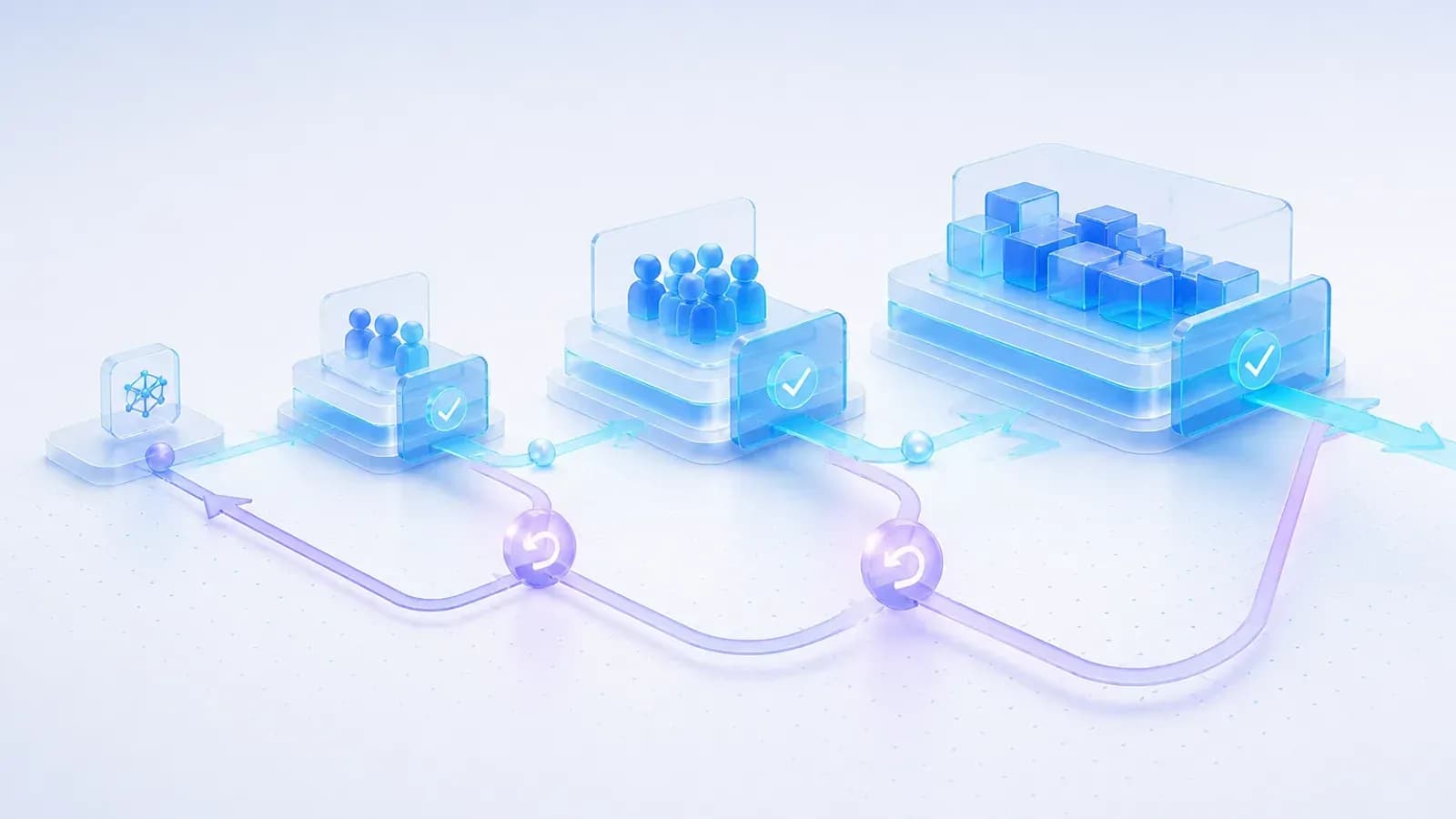
A staged AI rollout is not an all-staff release reduced to a handful of testers. It is a sequence of gates that limit impact. The common order is shadow mode, controlled users, controlled scenarios and gradual expansion, but shadow mode belongs only where requests can be copied lawfully and a comparable human or rule result exists. A brand-new process, open-ended drafting or a task with no meaningful comparator should start with controlled users or a bounded scenario. Each stage answers a limited set of questions. If the prewritten release conditions are not met, the system stays put or rolls back instead of expanding while the team explains away anomalies.
AI output varies with input, context and model state, so a successful demo cannot cover the long tail of production work. Gradual release collects production evidence while impact remains bounded; it does not promise zero risk. If the project still lacks fallbacks, named owners and the previous workflow, complete the work between an AI pilot and production before entering rollout.
A gradual release is a chain of decisions, not a fixed traffic curve
Conventional software rollout is often described as increasing traffic. AI deployment must also control users, tasks, data and actions. A small group reading internal material carries a different risk from the same group sending content externally; a large volume of drafts is different from automatic write-back. The release unit therefore cannot be only a user percentage. It must say who may use the system, for which task, on which data and up to what action.
Every stage needs entry conditions, an observation question, evidence sources and an exit decision. Entry conditions test readiness; the observation question limits what the round is trying to learn; evidence combines system logs, human review, business outcomes and user behaviour; the exit is expand, hold, degrade or roll back. The NIST AI Risk Management Framework treats governance, context mapping, measurement and management as connected activities. That is a useful rollout model: risk is not scored once before launch but updated through operating evidence.
Stage labels cannot replace scope. "Internal test" and "low traffic" do not guide operations. "Support may see suggestions; nothing is sent automatically; sensitive accounts are excluded; an escalation owner is online" does. Encode the boundary as system rules wherever possible.
Use shadow mode to test judgment without touching the business
In shadow mode, a copy of a real request goes to the AI, but its result is neither shown to the end user nor written to any system. The original workflow completes the task as usual. The project team later compares the AI result with the human result, existing rules or eventual business outcome. This stage should answer whether inputs represent real work, which cases fail and which important exceptions the evaluation set missed.
Shadow data must not be copied indiscriminately. The original permission, purpose and retention rules still apply, and sensitive fields should receive any necessary treatment before entering the evaluation path. Guard against future-information leakage as well. If a human decision was formed days later, record that timing; do not show the AI a conclusion that did not exist at the decision point and then claim predictive accuracy.
Classify failures rather than relying on an average score. Useful buckets include incomplete input, stale knowledge, conflicting rules, model judgment error, tool failure and cases that cannot be evaluated. Confirm that every class has an operational destination. A stable average can hide repeated failure in one high-impact scenario. Turning AI pilot acceptance into checkable criteria explains how to make the sample and decision rule auditable.
Controlled users test human–AI collaboration, not another offline benchmark
Once shadow evidence passes, choose typical target users who will do real work and report problems, with a manager able to arrange feedback and fallback. Project-team testers are unusually patient. Vague inputs, skipped steps and over-trust from ordinary employees are exactly what live release needs to reveal.
At this point, expose recommendations before high-impact actions. The interface should show evidence, scope and confirmation requirements, with low-friction ways to reject, hand over or report a problem. Human takeover is not a failed rollout; it is a critical sensor. Which tasks trigger takeover, why it happens and how much work follows determine whether the system actually removes work.
Do not reduce feedback to asking whether users liked it. Observe whether they check sources, mistake a draft for a conclusion, repeatedly rewrite prompts to force a preferred answer, or abandon the system after one failure. Make review responsibility concrete in training. The tiered AI output review checklist can anchor role instructions instead of telling everyone vaguely to "watch the risks".
Controlled scenarios keep risk inside a business boundary
After the user group succeeds, do not switch on every task in the department. Expand by scenario. Rank tasks by input controllability, judgment complexity, action impact and reversibility. Open scenarios with complete material, explicit rules and internal drafts before those requiring cross-system reads, external output or write-back. This order reveals actual risk more effectively than simply creating more accounts.
A practical release matrix has four axes: user scope, task scope, data scope and action scope. Widen only one axis in a round while holding the others constant, so a metric change can be attributed. If the release adds departments, introduces new tasks, changes the data source and enables automatic write-back together, the team will be unable to locate the cause of an anomaly or decide which change to reverse.
Order scenarios by failure impact and recovery difficulty, not by demo appeal. Reassess the first automation using the method for choosing an initial AI workflow. Where ERP, OA or another business system is involved, release capability separately along the read, recommend, write-back and execute integration ladder.

Promote on combined evidence, not one attractive metric
Every expansion should examine four kinds of evidence together. Quality evidence asks whether output is correct, grounded and within scope. Business evidence asks whether the task completed and created rework. Collaboration evidence covers adoption, edits, takeover and review burden. System evidence covers latency, failures, dependency incidents and resource use. Strength in one category cannot cancel loss of control in another; high adoption, for example, may mean users failed to review.
Comparison needs a baseline and a control. A baseline may be the quality, handling time and exception backlog of similar work before the rollout. A control may be comparable tasks that still use the old process during the same period. The canarying chapter of Google's Site Reliability Workbook advises selecting metrics that indicate problems, are representative and make the release attributable. The same principle matters for AI: a simple before-and-after comparison can misattribute seasonal, staffing or workload changes to the system.
Set gates from the organisation's existing baseline, risk tolerance and fallback capacity rather than copying a universal percentage. What matters is fixing the definitions before release: what counts as an error, how much human editing constitutes a failure, which observation window applies and who signs the decision. Changing the metric after seeing the result turns rollout into an exercise in defending a predetermined conclusion.
Separate hold, human degradation and immediate rollback
Not every anomaly needs a complete shutdown. Hold expansion when evidence is insufficient or unstable: keep the current scope while observing and repairing. Degrade to a human path when a class of tasks remains useful but automation is unreliable: disable the action while retaining recommendations or handover. Roll back immediately when continued operation could expand harm, breach a boundary or has already lost traceability. Each decision needs a defined owner and trigger.
- An unauthorised data exposure, security event or compliance incident should isolate the relevant entry point and roll back the affected scope without waiting for a larger sample.
- An incorrect write, external send or business action that exceeds the predefined compensation boundary should stop new actions and restore the former workflow.
- Missing audit logs, identity chain or version evidence that prevents reconstruction of who did what should pause the capability; loss of traceability is itself a release blocker.
- An error rate, service failure, response time or business rework level that remains beyond its preset gate should hold expansion; continued deterioration or spreading impact should trigger rollback.
- A human takeover queue beyond the duty team's capacity, or a high-impact failure whose cause cannot be located inside the agreed decision window, should degrade the work to its human path.
The operative word is predefined. Actual thresholds come from the old-process baseline, business tolerance and staffing capacity; an article cannot supply one number for every company. Each trigger also needs a scope: disable one action, one scenario, one department or the entire version. Prefer a contained rollback where containment is real, but do not understate the event merely to remain online.
Rollback ends only when the business is restored and new impact is reconciled
A rollback plan needs a switch, an old path, data reconciliation and communication. The switch should disable a high-risk capability without requiring another code release. The old path remains usable during the observation period. Reconciliation distinguishes successful, failed, timed-out-but-committed and queued requests. Communication tells users which results are invalid, which work must be repeated and when the path returns. Redirecting new traffic while leaving bad data behind is not a completed rollback.
Before launch, rehearse the hardest failure: make a dependency time out, let a write commit while its response is lost, and make the model version unavailable, then execute shutdown and restoration. Rehearsal surfaces problems a document misses: the old-workflow account was removed, the manual spreadsheet format changed, or the duty operator lacks permission to use the switch. Rollout reliability comes from these ordinary, testable preparations.
Do not redeploy unchanged immediately after rollback. Freeze the affected version, preserve evidence and distinguish a model issue from a data, prompt, rule, integration or training issue. After repair, return to the stage that can retest the failed assumption. A shadow defect returns to shadow mode; a failed automatic write returns at least to recommendation level. Recovery should match the layer where risk materialised.
Broad availability is a new operating state, not the end of rollout
When target users and scenarios have expanded, retain the release matrix, rollback switch and stage evidence. Business data changes, models and knowledge sources are updated, and people and permissions move. Passing once does not mean passing forever. A material change to model, prompt, tool or data source should re-enter the rollout stage that matches its impact rather than borrowing the old version's conclusion.
A mature release record explains the current scope, excluded scenarios, evidence behind the gates, the last incident and who may pause the system. It becomes the baseline for the next change, so every new owner does not restart from "it seems fine".
The purpose of gradual release is not to prove that AI is clever. It is to constrain impact while evidence is weak and to retreat when evidence deteriorates. Shadow mode protects the business, controlled users test collaboration, controlled scenarios test boundaries, gradual expansion tests stability, and explicit rollback criteria stop the team from scaling a known problem.