
From AI Pilot to Production: What Sits in Between?
The demo succeeded, the decision meeting approved it, and three months later the project still is not live. Pilots and production are separated by a stretch of road nobody planned: dirty data, fallbacks, permissions, monitoring, ownership. This article maps that road.
Key takeaway
A POC proves feasibility under ideal conditions: curated data, demo paths, constant attention. Production needs five more things — fallbacks, permission boundaries, monitoring, a named operator with an SOP, a rollback plan — then staged rollout. What kills pilots is unowned operations; budget it at approval.
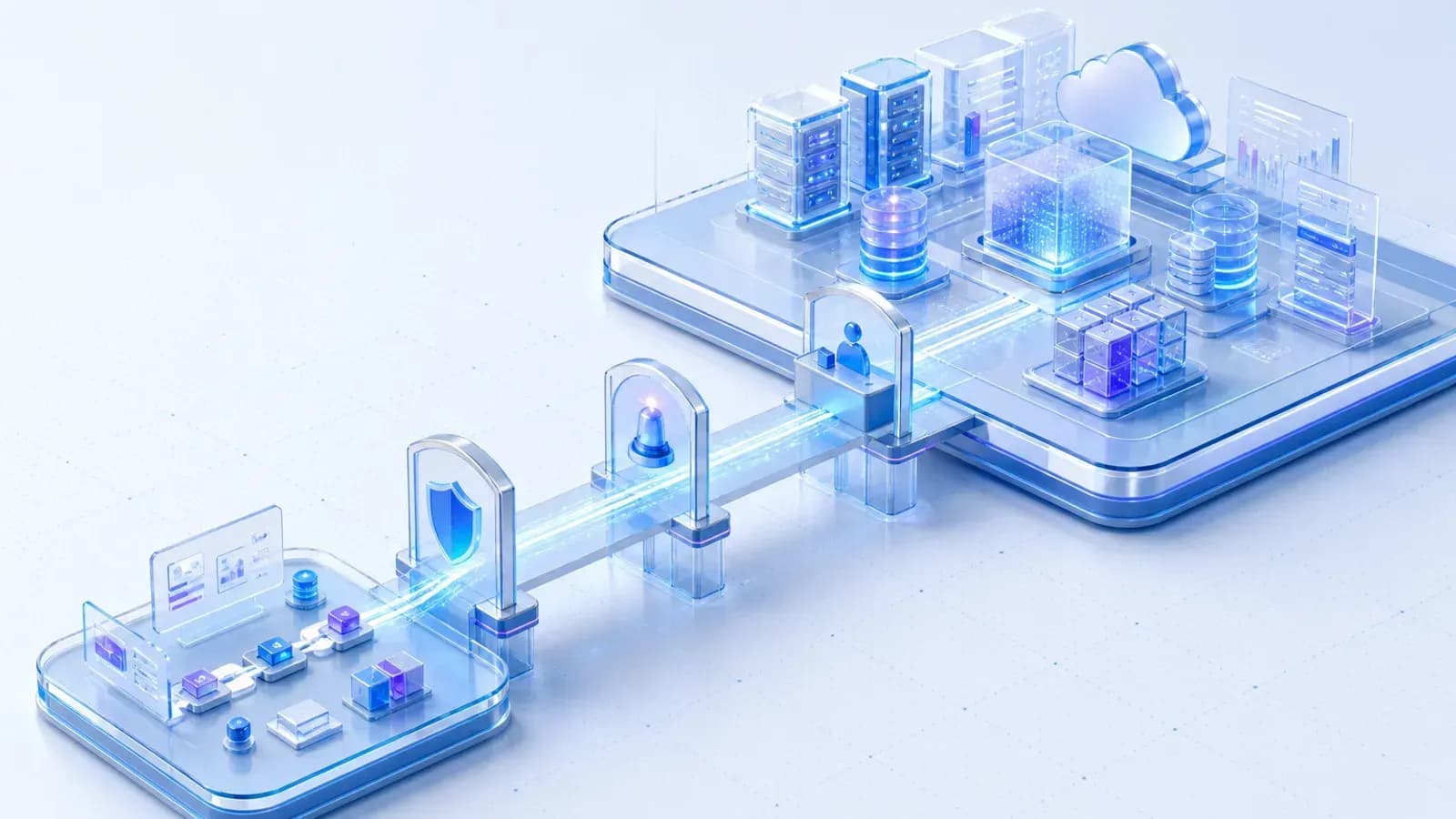
The demo meeting went well: accuracy looked good, the boss nodded, the room moved on to launch dates. Three months later the project is still sitting in the pilot environment — nobody opposes it, and nobody is pushing it forward.
This kind of stall is common in enterprise AI, and it is usually not a discipline problem. Between a pilot and production lies a stretch of road that has to be planned deliberately; when nobody plans it, the project simply stops. This article walks that road.
A pilot succeeds under sheltered conditions
Start by admitting the obvious: a POC runs in a pampered environment. The data was hand-picked — clean formats, complete fields, ideal samples. The run followed the demo path, steering around inputs that looked troublesome. And someone was watching the whole time, quietly patching every problem, none of it written down.
Production removes all three protections at once. Real data arrives as skewed scans, half-empty forms and hopelessly colloquial descriptions; exceptions stop detouring and come in at full volume; and when the system fails at two in the morning, nobody is standing next to it. High pilot accuracy therefore does not imply a safe launch — a pilot demonstrates feasibility; production tests reliability. Two different exams.
Five things to put in place before launch
The core work between pilot and production is replacing someone-is-watching with the-system-holds-up-on-its-own. Concretely, five things.
Fallbacks and degradation: when the AI cannot process an input, or confidence is too low, where does the case go — to a human, into a queue, or straight back to the sender? The degraded path needs an actual rehearsal, not a line in a document.
Permissions and data boundaries: pilots run on generous permissions for convenience; before launch they must be narrowed — what the system may read, which systems it may write to, and whether anything outbound needs human sign-off. Four Data Boundaries to Set Before Using AI on Company Material covers how to draw these lines.
Monitoring and alerts: at minimum, three numbers someone can always see — volume processed, failure rate, human-takeover rate. Anomalies must raise alerts on their own; discovering outages through user complaints is the most expensive monitoring strategy there is.
An operations owner and an SOP: who handles errors, who updates the material, how often the numbers get reviewed — written down, with a person's name on each line. Shared responsibility in production means nobody is responsible.
A rollback plan: if two weeks in it clearly is not working, how do you return to the old way of working? How long does the old process stay available, and how does the data reconcile? A launch without a rollback plan is a bet without a stop-loss.
Scale in stages: one department, observe, then the next
Even with all five in place, do not switch everyone over at once. The safer rhythm is a staged rollout: one department, or one document type, runs the new process first; an observation window follows, judged against acceptance criteria written in advance — Writing Pilot Acceptance Criteria That Can Actually Be Checked shows how to turn a vague sense of working well into something checkable. Pass, then expand to the next department.
Expect every expansion to surface new kinds of exceptions: departments fill in forms differently, draw on different sources, keep different unwritten rules. That is not a failing project — it is the normal texture of rollout. Reserve schedule for handling the new exceptions instead of treating them as incidents.
What actually kills pilots is rarely technical
Most pilots do not die because the model was weak. They die because nobody owned the cost of running the thing after launch.
In the enterprise settings ChengXuYuan has observed, the script is familiar: during the pilot, the project team's enthusiasm absorbs every problem; at launch, it dawns on everyone that the system needs someone to feed it material, watch its alerts and handle its edge cases indefinitely — effort nobody sized at approval time and nobody carries in their objectives. So every department assumes it is someone else's job. The project does not fail. It just quietly stops being anyone's.
The fix belongs at approval time: write long-term operations into the project budget — who owns it, how many hours a week, whose performance review it lands in. If those questions cannot be answered, the project is not ready to approve. Six Questions to Ask Before Approving an AI Project includes the full checklist.
Treat launch as the midpoint
Looking back: the POC only answered whether the thing is technically feasible — that is the starting line. Launch is not the finish line either; it is the midpoint where the system starts taking the real world's exam. The return on the whole project comes from the long stretch after launch, when it is actually operated.
Which suggests a plain test of whether an AI project will make it: is the organisation willing to pay for its operation after launch? If yes, the five items above are just a checklist. If not, even a flawless demo is only a flawless demo.