
What Is RAG? The Technology Behind Enterprise Knowledge Bases
Why does a general AI tool start making things up the moment you ask about your own company? RAG — retrieval-augmented generation — exists to fix exactly that: look up your material first, then answer. A plain-language explanation of how it works and when it matters.
Key takeaway
RAG (retrieval-augmented generation) makes an AI retrieve relevant content from your document base before answering, then compose the answer from what it found. It leaves the model untouched, costs far less than retraining, and can cite sources. Most enterprise knowledge bases are built on it.
Many executives start taking "enterprise AI" seriously after one particular disappointment. They have been using a general AI tool happily for weeks, then casually ask, "What is the warranty policy for our Product A?" The tool answers fluently — and the content is invented. Right product name, wrong policy.
The tool is not broken. It simply knows nothing about your company. Understand that, and you understand why RAG exists.
Two gaps a large model cannot avoid
A large model's knowledge comes from the public material it read during training. That creates two hard limits: a time cutoff — anything that happened after training is unknown to it — and a private blind spot — your product manuals, pricing rules and internal processes were never in its training data.
Worse, when a model does not know the answer, it rarely says so. It generates something grammatical and plausible instead — the behaviour usually called hallucination. For an individual user that is a nuisance. For a business it is a liability: once a support agent quotes an invented warranty policy to a customer, the problem is no longer technical.
The idea behind RAG: turn a closed-book exam into an open-book one
RAG stands for retrieval-augmented generation. The name is clumsy; the idea is not: look things up before answering.
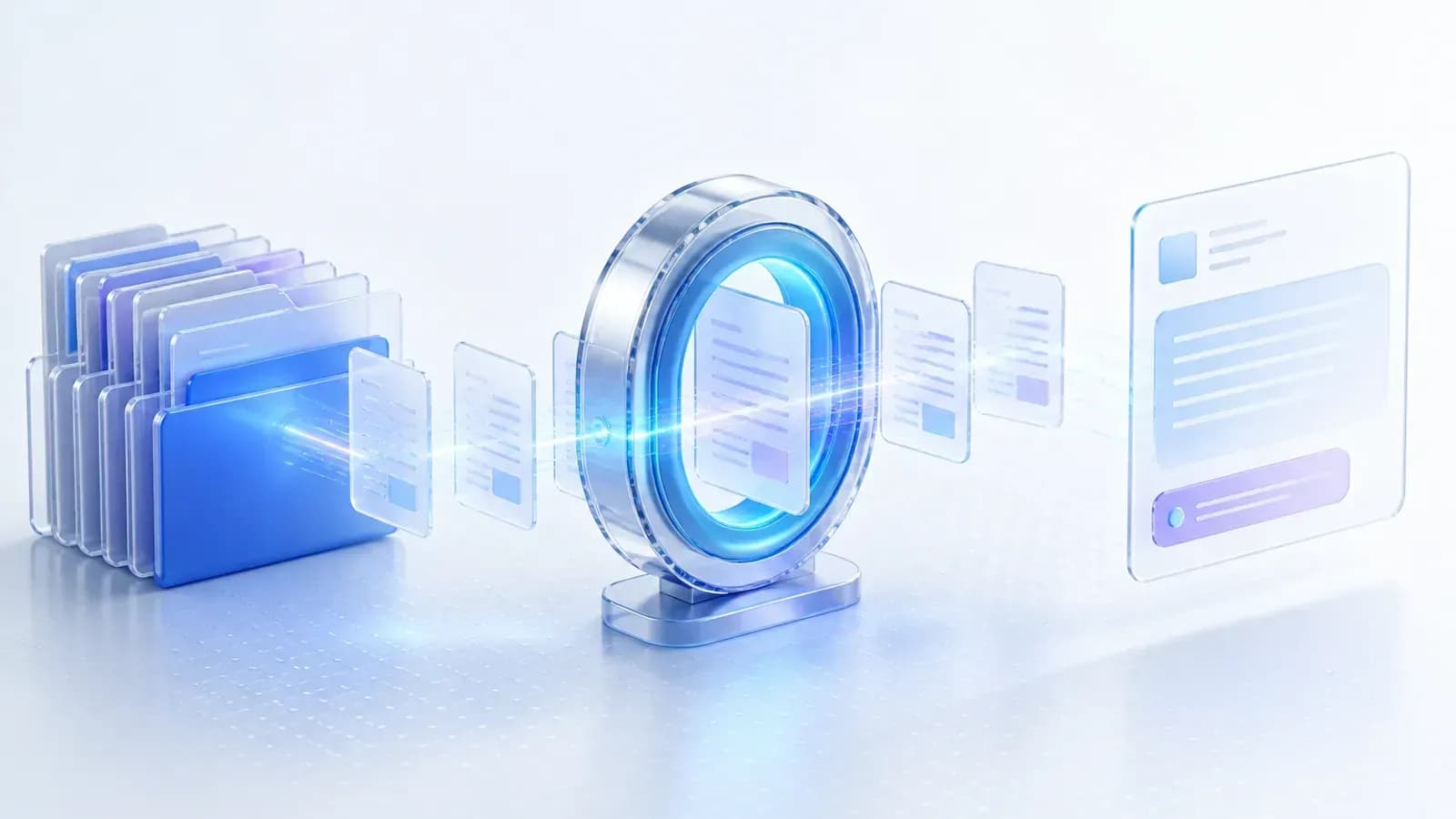
Without RAG, the AI sits a closed-book exam, answering purely from what it memorised in training. With RAG, the exam becomes open-book: the system first pulls the passages most relevant to the question from a document base you control, then hands those passages to the model with the instruction "answer based on this material." The model stops relying on memory and starts relying on what is in front of it.

What actually happens during one RAG answer
Take the warranty question. Behind an enterprise knowledge base, roughly five things happen: your manuals and policy documents are split into passages and indexed in advance; when the question arrives, the system retrieves the most relevant passages (semantic search handles the fact that "warranty" and "guarantee" mean the same thing); the passages and the question are assembled together and sent to the model; the model composes an answer from those passages; and the answer comes back with its sources attached.
That last part — citations — is worth a lot in a business setting. When the answer says it came from section 3.2 of the after-sales handbook, whoever reads it can open the source and check. Trust has somewhere to stand. This is why serious knowledge base products all show their sources.
How this differs from training your own model
Many companies' first instinct is "train a model on our own material." That route — fine-tuning — has its uses, but it solves a different problem, and for most knowledge Q&A scenarios RAG is the more sensible starting point:
- Freshness: when a document changes, RAG only needs the document base updated — effective the same day. Fine-tuning means running the training process again.
- Cost: RAG's main cost is retrieval and storage infrastructure, an order of magnitude below training. Fine-tuning needs curated training data, compute and evaluation.
- Traceability: RAG answers can cite their sources. A fine-tuned model gives you an answer with no way to know which document it drew on.
- Boundaries: RAG can enforce permissions — who may retrieve which documents. Knowledge baked into model weights cannot be isolated that way.
In short: if you want the AI to know facts about your company, look at RAG first. Fine-tuning earns its place when you want the AI to acquire a particular style of writing or judgment.
Why some RAG knowledge bases still disappoint
RAG's job is to put the right material in front of the model. It does nothing about the quality of the material itself. When a knowledge base underperforms, the cause usually sits on the document side: files that are outdated or contradict each other, passages split so poorly that retrieval returns fragments without context, or simply nobody maintaining the content until nobody trusts it. We covered that ground in A Knowledge Base for Small Teams — govern the material first, and RAG has something to amplify.
Put bluntly, RAG is an amplifier. Accurate material gets amplified into accurate answers. Messy material gets packaged into confident-sounding nonsense.
Three questions to decide whether RAG concerns you
First: does your team regularly spend time hunting for answers — digging through documents, asking the veteran colleague, waiting for replies in group chat? Second: do those answers live in reasonably stable sources — handbooks, policies, past project records? Third: do wrong answers carry a cost — customer complaints, mispriced quotes, slow onboarding?
Two yeses out of three, and an enterprise knowledge base belongs on your consideration list — with RAG as its technical foundation. For how to build one from zero, continue with How to Build an Enterprise AI Knowledge Base.
One thing to remember
RAG is not new — the original paper was published in 2020. It only entered the enterprise conversation once model capability caught up in the past two years. As a decision-maker you do not need the technical detail. One sentence is enough: how reliable an AI's answer is depends half on the model, and half on what material you let it see. RAG is responsible for the second half.