
What Is MCP? Why Everyone Is Talking About This Protocol
A protocol barely a year and a half old has been adopted by rival AI vendors and handed to a neutral foundation. What MCP actually solves, how it relates to function calling, and how to factor it into vendor selection.
Key takeaway
MCP (Model Context Protocol) is an open standard for connecting AI applications to tools and data — the USB-C of the AI world. Anthropic released it in November 2024; the industry adopted it through 2025; it now sits under neutral Linux Foundation governance. It cuts integration cost and lock-in.
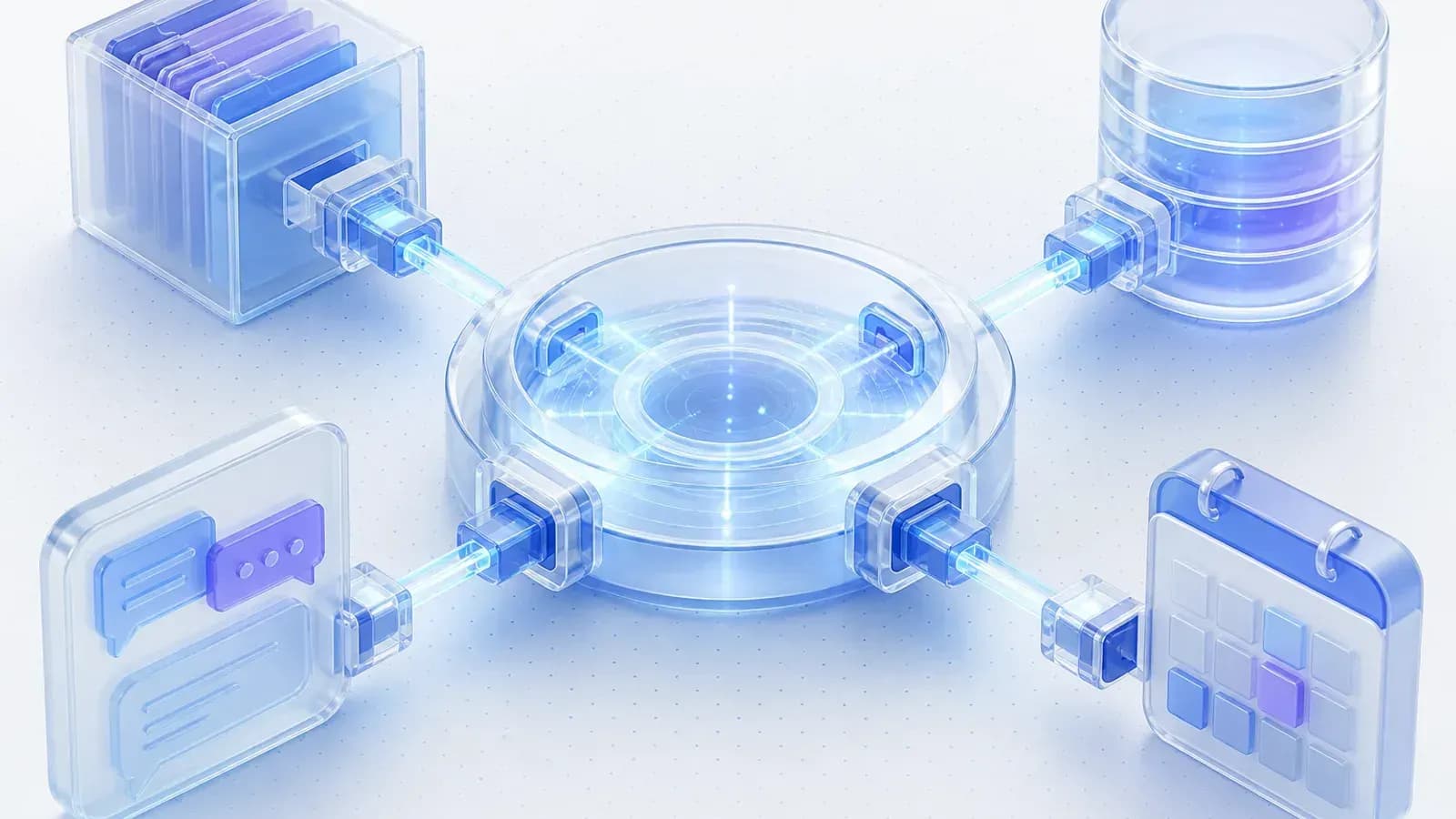
Remember the drawer full of charging cables? One plug for the phone, another for the camera, a third for the headphones — every new device added a cable. Then USB-C gradually unified the port, and "hunting for the right cable" quietly disappeared from daily life. Over the past year and a half, the connections between AI applications and business systems have been going through the same consolidation. This time the standard plug is called MCP.
The acronym has travelled from developer circles into vendor-selection meetings, so it has earned ten minutes of a manager's attention: what problem does it solve, and do you need to care yet?
What MCP is: a wiring standard everyone accepts
MCP stands for Model Context Protocol. It is an open protocol that defines how AI applications talk to the outside world — databases, document stores, chat tools, business systems: how a tool declares what it can do, how an AI application discovers and calls it, and in what format results come back.
The key word is "standard". Before MCP, letting an AI assistant read your CRM data usually meant writing a bespoke integration for that assistant times that CRM; switch either side, and you wrote another one. MCP standardises the exchange: the system side exposes an "MCP server" once, and any AI application that speaks the protocol can plug in. Hence the comparison the whole industry uses — USB-C. Once the port is standard, any device pairs with any charger, no matchmaking required.
The problem it solves is a multiplication
Behind the analogy sits very practical arithmetic. Suppose a company runs 5 AI applications and wants them all connected to 8 internal systems. Bespoke integration means, in theory, 5×8=40 separate projects. With a shared standard, each application supports the protocol once and each system exposes one standard endpoint: 5+8=13. The more parties involved, the more brutal the gap between multiplying and adding — the same mathematics that made shipping containers, USB and QR-code payments win.

How it relates to function calling
Readers of our function calling explainer may ask: doesn't tool use already exist? It does, and the two do not compete — they divide the work. Function calling is a capability of the model: it can fill in a structured request to use a tool. MCP is the standard for how tools plug in: where that request goes, how a tool mounts itself, what format both sides exchange. One governs whether the model can use tools; the other governs how easily tools connect. Together they form the full chain of "AI that does work".
Why it became industry consensus within about a year
Anthropic released MCP as an open-source protocol in November 2024 — at first, one company's proposal. The turning point came in late March 2025, when OpenAI, its biggest rival, publicly announced MCP support across its products; Google, Microsoft and other major vendors followed over the next months. Then in December 2025, Anthropic donated MCP to the newly formed Agentic AI Foundation under the Linux Foundation — co-founded by Anthropic, OpenAI and Block, with support from Google, Microsoft, AWS and others. The protocol now sits with a neutral body, owned by no single model vendor.
For a business, that trajectory matters more than any technical detail: when direct competitors agree to share a standard and hand its ownership to a neutral body, the standard tends to stay. Betting on it carries less risk than betting on any one vendor's proprietary integration.
How to use the ecosystem when selecting vendors
If you are choosing AI products or planning internal systems, the MCP ecosystem translates into three concrete moves:
- When evaluating AI applications, put "supports the mainstream protocol ecosystem" on the checklist — support means cheaper connections to future systems.
- When building internal systems, have the team expose a standard interface once — reusable no matter which AI application you adopt later.
- When reviewing vendor proposals, be wary of "works only with our suite" private integrations — features may impress, but the cost of lock-in belongs in the total price.
The reasoning matches how you would assess an AI agent product: capabilities iterate quickly; interfaces and standards are the longer-lived asset.
A dose of cold water: not everyone needs to act now
MCP pays off where connections multiply — many AI applications, many systems to reach. If your team currently uses one or two AI tools and has no multi-system integration on the horizon, the 5+8 arithmetic does not apply to you yet, and no project needs to be spun up for the sake of a trend.
The right posture is to put MCP on your question list for vendor selection, not your project list: asking "do you support the standard protocol?" costs nothing today, and when integration needs eventually arrive, that one question will have saved real money.