
Breakdown: A Sales Follow-Up Workflow, So Leads Stop Dying of Neglect
Most lost leads are not lost in negotiation — they are simply never contacted again. Following one lead through its lifecycle, this piece breaks down status fields and time rules, reminders with context, AI-drafted follow-ups under human review, and escalation — plus hard anti-nuisance limits.
Key takeaway
The workflow rests on honestly maintained lead states: new, contacted, awaiting reply, dormant, closed. On top sit four layers: time rules per state, reminders with context, AI-drafted follow-ups reviewed before sending, and escalation when reminders are ignored — plus hard anti-nuisance limits.
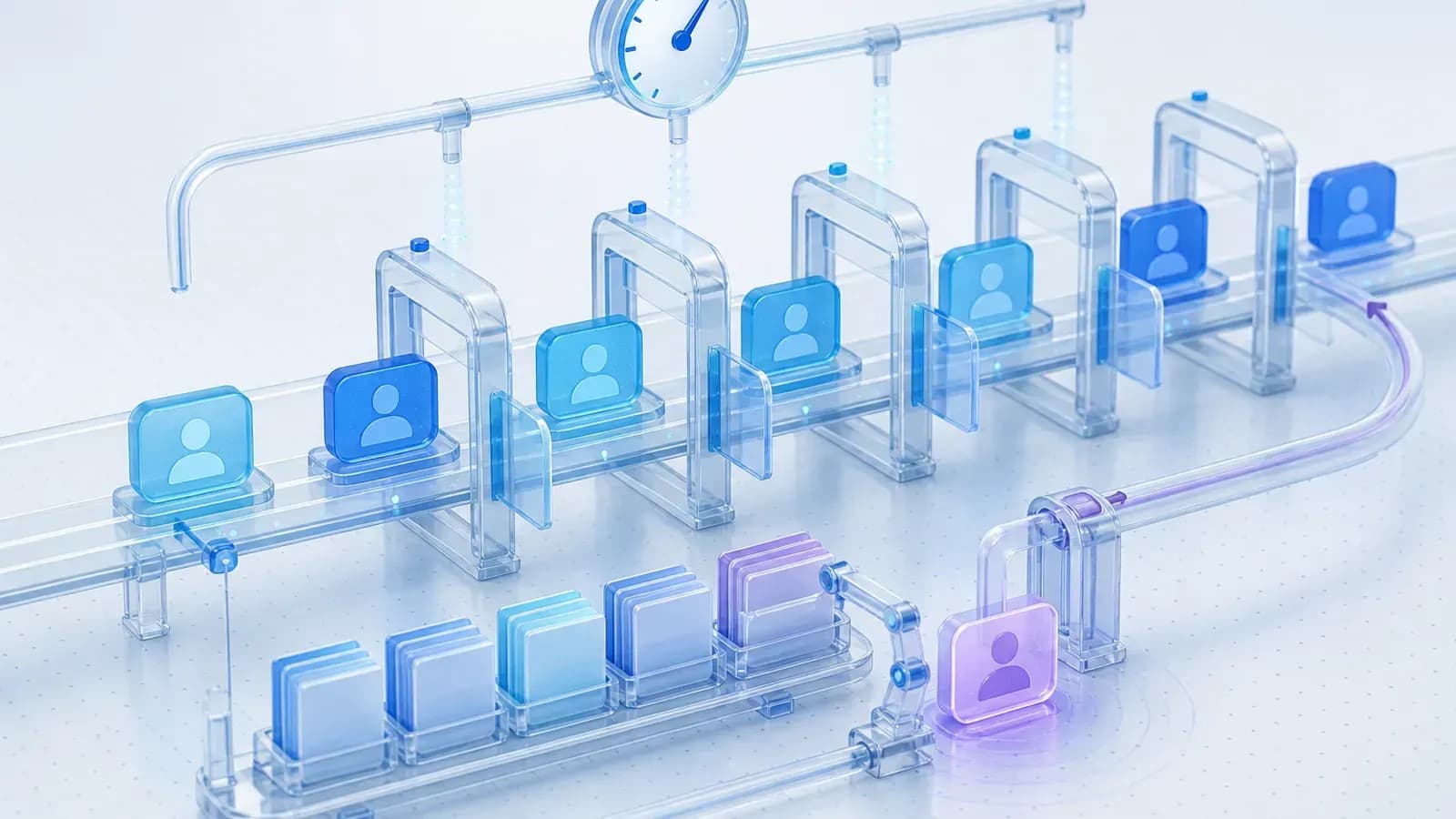
When teams debrief a lost deal, they look for the dramatic cause: price too high, wrong solution, a competitor swooping in. But among the small and mid-sized businesses ChengXuYuan works with, the more common way to lose a lead is far quieter — the customer asked a round of questions, the salesperson answered them, and then neither side ever spoke again. Leads rarely die of rejection. They die of being forgotten.
Forgetting is not an attitude problem. With twenty or thirty leads in hand, each at a different stage, remembering "who needs a message today" from memory was never realistic. This workflow exists to solve exactly that: "time to follow up" should be said by the system, not recalled by a person. What follows walks one lead through its lifecycle, unpacking the mechanism at each stage.
The precondition: leads have states, and the states are true
Every reminder rule stands on status fields. The minimum viable set is five: new, contacted, awaiting reply, dormant, closed. At any moment a lead sits in exactly one state, with an owner and a last-action timestamp. The exit criterion: pick any lead at random and you can immediately answer what state it is in, when it was last touched, what happens next, and whose it is.
Harder than defining the fields is keeping them honest. If salespeople do not update states, every reminder is noise — the system nags them about a lead they spoke to yesterday, and after the second time they mute everything, killing the whole mechanism. So updating must cost as little as possible: one tap after the call, not a form back at the desk. Where leads come from and how they get assigned is a separate upstream process, broken down in Routing Inbound Inquiries to the Right Person.
New leads: the clock starts the moment they arrive
The first stage has the simplest rule and the highest value: every new lead gets its first contact within an agreed window. How long is the team's call — same day, twenty-four hours — what matters is that once set, the deadline is hard, with no discount for "this one doesn't look like a big deal". The reminder goes to the owner personally, with context attached: which channel the lead came from, what they wrote, any previous interactions. The salesperson should be able to act straight from the reminder, not spend ten minutes digging for background first.
The failure boundary appears right here: if the window closes with no action, the answer is not resending the same reminder — repetition only trains people to ignore it — but escalation, covered below.

Awaiting reply: where most leads go to die
"Contacted, awaiting reply" sounds perfectly healthy. In practice it is the graveyard: the wait becomes forgetting, and somewhere during the forgetting the customer signs with someone else. The rule for this stage: once the agreed number of days passes with no response — say three working days — remind the owner to make another touch.
This is also where AI genuinely earns its place: drafting the follow-up from the lead's communication history — where the last conversation ended, what the customer cared about, what new information this message offers. Two boundaries are non-negotiable. Drafts are sent only after human review; AI's judgment of relationship nuance is not yet reliable, least of all in tone. And every follow-up must give the customer a reason to respond — an extra document, an answer to last week's question, one specific ask. Three consecutive "have you had a chance to consider?" messages are not follow-up; they are debt collection.
Dormant leads: wake-ups have a rhythm, and a ceiling
A lead with no contact past an agreed period moves to dormant. Dormant is not dead — plenty of needs are merely postponed. The wake-up rule: touch once per cycle (quarterly, for instance), and always with a pretext — a new piece of content, a product update, an observation about their industry. A wake-up with nothing to say amounts to repeating "we still exist" three times, and only spends the customer's patience.
Anti-nuisance limits belong in the process itself, not in each salesperson's sense of tact:
- Frequency cap: per lead, outbound touches per month stay under an agreed count — calls, messages and email counted together.
- Exit condition: the moment a customer says "not interested" or "stop contacting me", mark the lead closed, stop every automated reminder, record the reason — and nobody gets to "try their luck" again.
- Content floor: every touch carries new information; if there is nothing new this time, do not send — wait until there is.
Closing a lead is not failure. It reallocates a finite follow-up budget to the leads that still have a chance.
Escalation: where the process proves itself
Every reminder system eventually meets "reminded, but nothing happened". A reminder must not vanish silently: past the deadline with no action, it escalates to the manager automatically. The purpose is not catching slackers — it is putting the decision in front of someone with the authority to make it: reassign the lead, lower its priority, or confirm it abandoned. Each escalation leaves a record: which lead, how overdue, how it was resolved. Without escalation as the backstop, a reminder system degrades within months into a pile of dismissed red dots — functionally the same as having none.
Process first, tools second
Everything above can start life in a shared spreadsheet plus calendar reminders. Once it runs, then consider whether to adopt a CRM and which one — at that point your requirements will be concrete: can status fields match our definitions, are reminder rules configurable, how does the escalation chain work. In the other order — buying the tool before thinking through the process — you mostly relocate "forgot to follow up" into a more expensive system. Follow-up is one link in the acquisition chain; for what sits upstream and downstream — where leads come from and how they move to close — continue with how AI supports lead generation.