
Breakdown: From Meeting Notes to Tasks — the Quality Gates in Between
Working backwards from one bad task — assigned to someone who was not in the meeting, deadline "ASAP" — this piece breaks the pipeline into five stages: transcription, minutes, action items, task creation and owner confirmation, with the typical failure and the gate design for each.
Key takeaway
Five gates sit between a meeting and trustworthy tasks: transcription with a team glossary, minutes that separate decided from discussed, action items with owner, deadline and deliverable, careful task creation, and owner confirmation — the step that turns records into commitments.
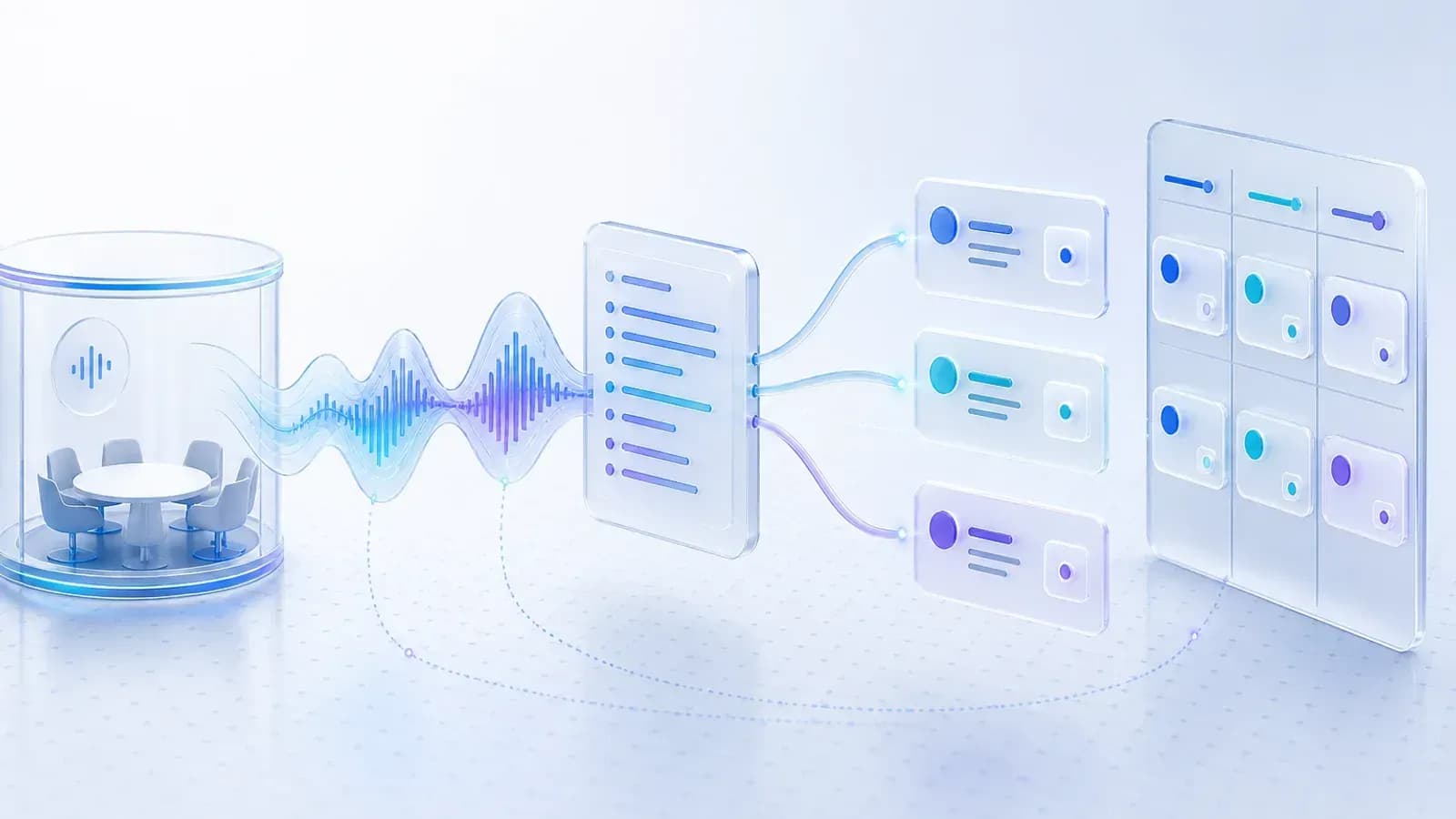
Picture this: Monday's team meeting ends, and the system automatically produces the minutes, extracts the action items, and creates the tasks. At Friday's review, one task — "evaluate the supplier proposal" — sits untouched on the board. It was assigned to someone who was not in the meeting. Its deadline reads "ASAP". And the sentence it came from was an offhand remark that was never actually agreed.
Trace it back and every stage contributed a small error: transcription misheard a name, the minutes recorded a discussion as a decision, the extraction step missed the absent deadline, and task creation quietly picked the first match from a list of similar names. None of the errors is large on its own; chained together they produce a zombie task nobody owns, nobody does, and nobody dares delete. Which is why the point of this breakdown is not "how to automate" but "where to put the gates".
The full pipeline has five stages: audio transcription, minutes generation, action item extraction, task creation, owner confirmation. Its defining property: each stage treats the previous stage's output as fact — the further downstream an error travels, the more it costs to correct. So every stage needs its own gate, catching the failure most typical of that stage.
The transcription gate: names and internal jargon
General transcription models handle everyday language well enough; the errors cluster on words they have never seen — homophone names, internal project codenames, industry terms. The gate: feed the transcription stage a team glossary of names, projects, products and standing terminology, and keep it updated as the organisation changes. The exit criterion can be concrete: spot-check a sample, and key nouns — people, projects, numbers — must be error-free, while ordinary wording may have flaws. For words the system cannot resolve, keeping the raw audio flagged for confirmation beats letting it guess the nearest lookalike.
The minutes gate: separate "discussed" from "decided"
This gate catches errors of status: three options were kicked around, and the minutes announce "the meeting decided on option B"; one person's opinion becomes a collective conclusion. The design is a template that forces every statement into one of three columns: decided, pending, discussion only. Each item marked as decided must point back to the exact wording in the transcript — anything that cannot is demoted to discussion. The asymmetry is deliberate: a real decision misfiled under discussion will be fished back out by a reader; a discussion mislabelled as a decision goes straight on to become a task. The tier-then-review approach generalises beyond minutes — see Reviewing AI Output: A Tiered Checklist.
The action item gate: no owner, no deadline — sent back
"Follow up on the supplier thing" — who follows up? What does finished look like? By when? Let that into the task system and the meeting's vagueness is simply relocated onto the board. The rule at this gate is hard: an action item needs three elements — owner, deadline, deliverable (what gets handed over when it is done) — and missing any one sends it back to the meeting chair to complete. During extraction, AI may only mark missing elements as "to be filled"; it must never invent defaults. A system that guesses "due Friday" is worse than a blank, because it looks deliberately set.
The task creation gate: the least glamorous, the easiest to fumble
The hop from action item into the task system is technically trivial and fails in the quietest ways: the wrong person among similar names, the task filed under the wrong project, the same item created twice because it was phrased two ways. Two checks make the gate: deduplicate against existing tasks before writing, and whenever a person or project match is ambiguous, stop and ask instead of defaulting to the first hit. The checks cost almost nothing; teams that skip them usually pay it back two weeks later in an awkward accountability meeting.
The confirmation gate: why the owner's click cannot be skipped
By this point someone always proposes dropping the last step: "we have automated everything — making a human click confirm is redundant." It is the opposite. This step is the foundation of the whole pipeline. The cost of one wrong task is never just the task: the misassigned person either wastes the effort or ignores it; the person who should be doing it assumes someone is; two weeks later the accountability discussion dissolves into competing readings of the minutes. Those organisational costs dwarf two minutes per person per week spent clicking claim.
The confirmation itself should be light: claim in one click, reschedule in one click, reject in one click with a reason. A rejection is not a process failure — it is the cheapest possible moment to catch an error. The same mistake costs ten seconds at the confirmation gate and a meeting once it is discovered on the board. A task's authority comes from its owner claiming it, not from the system creating it.
Which meetings deserve this pipeline
The pipeline has build and upkeep costs, and not every meeting earns them. Recurring team meetings and project meetings fit best: fixed structure, high likelihood of action items, known participants. One-on-ones and brainstorms do not — the former trade on candour, which recording itself erodes; the latter are not supposed to output tasks at all, and forcing extraction kills the divergence they exist for. For judging which routines to automate first, the framework in Digitise Repetitive Work First applies unchanged: frequent, structured, and cheap to get wrong goes first.
What it actually produces is not minutes
The real product of this pipeline is not a record of the meeting — it is the conversion of "things said in the room" into "things someone has claimed".
Of the five gates, the first four protect information from distortion; the last one establishes ownership. Skip the first four and the tasks are wrong. Skip the last and the tasks have no owner. Both failures end the same way: a busy-looking board, and very little actually done.