
B2B vs B2C Content Marketing: The Decision Path Changes the Work
B2B and B2C content marketing are not higher and lower forms of the same craft. Their differences come from how purchases happen. This guide compares decision chains, cycles, evidence, channels, conversion and reuse, then gives hybrid businesses a way to choose.
Key takeaway
B2B and B2C content marketing differ mainly in who joins the purchase, how long it takes and which risks need proof. B2B content often helps several roles validate and advance a decision; B2C content more often links discovery, preference and action in a shorter path.
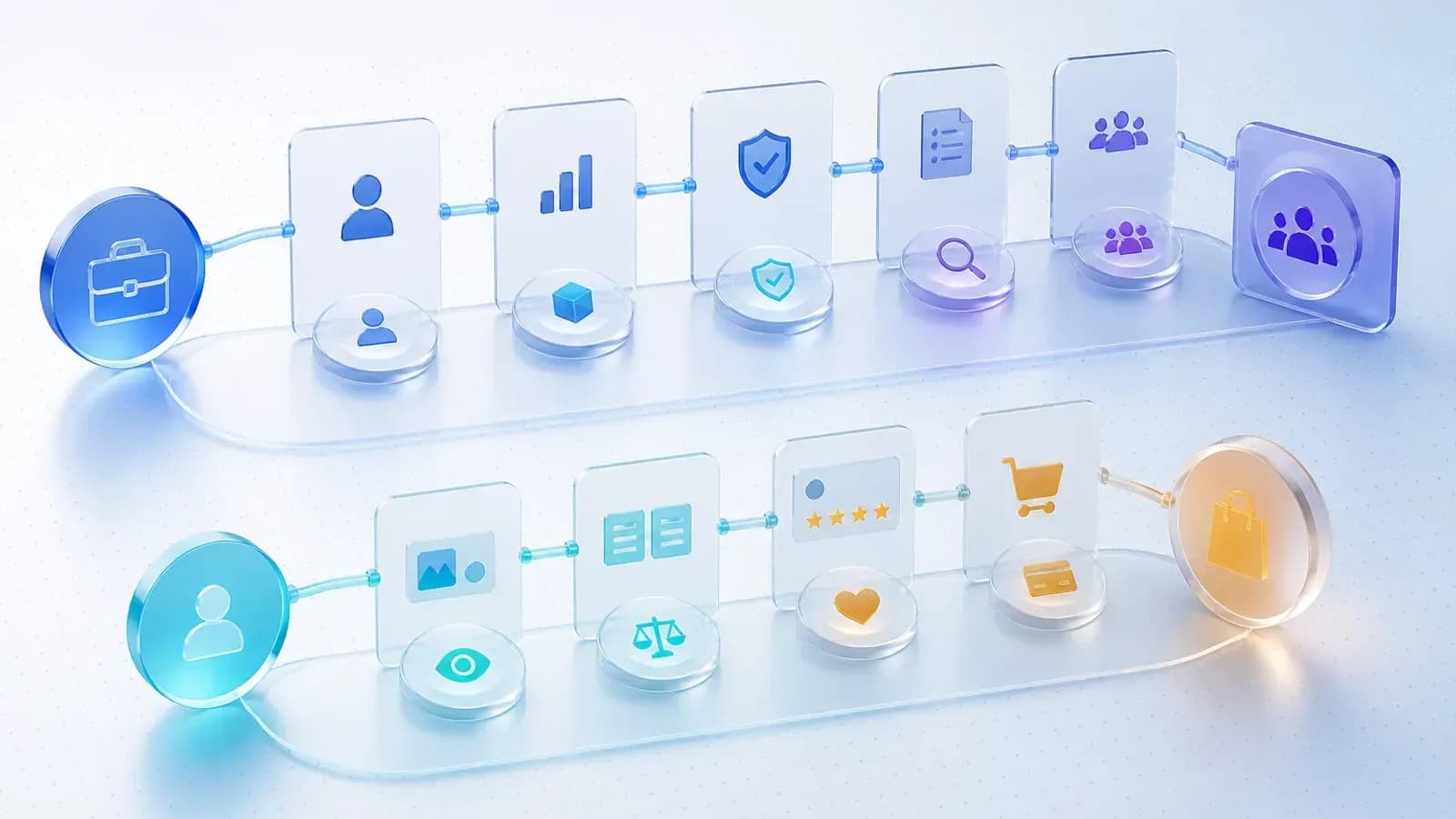
The central difference between B2B and B2C content marketing is not that one sounds professional while the other sounds entertaining. It is how the purchase gets made. Change the number of participants, the risks they carry and the steps between interest and payment, and the job assigned to content changes with them. Mapping the transaction before choosing topics, proof and channels is more reliable than copying whatever performs well on a platform.
Neither model is superior. Selling to businesses does not condemn a brand to solemn long-form writing, and selling to consumers does not reduce content to emotional impulse. B2B still needs preference and confidence; B2C still needs specifications and credible promises. What differs is who validates each element, when it appears and which action genuinely moves the purchase forward.
The difference starts with the decision unit, not the tone of voice
In a typical B2C transaction, the decision unit is an individual or household. The person who encounters the content will often use the product, pay for it or directly influence the payer, so one piece can identify a need, build preference and prompt action in one sequence. Expensive durable goods, education and health-related services may involve several people, but there are usually fewer distinct roles and feedback returns quickly to the buyer.
A typical B2B purchase can involve the user, a department owner, technical or security reviewers, procurement, finance and a final sponsor. Each asks a different question: will it make daily work easier, can it integrate, are the terms acceptable, what risk and return does it carry? Content addresses a decision unit, not one persona. A topic therefore needs role-specific entry points backed by one consistent fact base; otherwise material forwarded inside the buying organisation begins to contradict itself.
In practice, a role decision table is more useful than starting with age and job-title personas. For every participant, record the decision they must make, the information they need, the objection they can raise and the next action available. The table exposes gaps quickly: when all material explains features to users but nothing can be forwarded to security, procurement or the sponsor, the lead may look active while the decision remains stuck inside the organisation.
The cycle changes the rhythm: trigger short paths, sustain long ones
The buying cycle determines whether content must produce action now or preserve momentum. In a shorter B2C path, the situational trigger, product explanation, risk reduction and action can all sit on one page or in one video. Once the visitor leaves, the need window may close quickly. Content therefore pays particular attention to timing, repeated exposure and friction at the point of action.
A longer B2B path does not call for one extremely long article. It calls for material that hands the decision on across weeks or months: problem education supports an internal case, comparison guidance narrows options, implementation material tests feasibility, and cases and limitations help a sponsor explain the choice. Low-risk business purchases can be quick and expensive consumer decisions can be slow, so classify by the actual decision clock, not merely by whether the buyer is a company or a person.

Evidence should match the risk, not simply increase in volume
B2C evidence often reduces the individual's cost of making a poor choice: an honest demonstration, specifications and price, conditions of use, return or service terms, and differences across user situations. That evidence may be rigorously rational or make the fit visible through a scene. Either way it sits close to the choice, without requiring a separate round of organisational review.
B2B evidence has to survive forwarding and scrutiny. It may need to cover compatibility, implementation ownership, access and security, total cost and maintenance boundaries. A case study is not decorative endorsement here; it lets several roles inspect the context, work, evidence and limits. See how to structure a credible customer case for the full method. Evidence strength should match decision risk; a precise number that cannot be checked can weaken rather than strengthen the claim.
Choose channels by the decision action, not a B2B or B2C label
No channel belongs naturally to one model. Consumers search for long-form guidance, and business buyers may first encounter a supplier in a short video. The useful question is whether customers use that channel to discover, compare, validate or contact. Feeds can create relevance, search and the website can answer active questions, communities and email can continue an explanation, and sales material can travel inside an organisation.
The same fact can travel across channels, but the piece cannot simply be copied. A B2C creative idea needs a new opening and pace for each viewing context; a B2B judgment needs a new order and depth for each role. The principle in multi-platform content distribution done properly—one core in several platform-native forms—applies to both. What changes is the step each channel owns.
Conversion differs: an order is only one valid outcome
B2C teams can often define conversion as adding to basket, ordering, visiting a store, renewing or buying again, with a relatively visible line from content to revenue. Views, likes and saves still do not equal purchases. Measurement must separate platform interaction, product-page visits, submitted orders and fulfilled transactions instead of allowing the easiest number to grow to stand in for the business result.
A B2B contract rarely follows one reading session. Better conversions are the next actions that carry intent: opening implementation material, asking a specific question, inviting another stakeholder into a meeting, or becoming a sales-accepted opportunity. Marketing and sales also need an agreement on what information justifies a hand-off and who follows up. The four practical stages where AI supports acquisition offers a wider view of visibility, contact and follow-up. Conversion should mean the decision advanced, not that a button registered a click.
The measurement window must follow the cycle as well. A short-cycle business can compare exposure, visits and orders relatively quickly; a longer-cycle business needs a timeline of first touch, critical material used, new roles entering and sales progress. Judge only the first few days and deep B2B content is dismissed too soon. Attribute every deal over several months to one article and its contribution is overstated.
Reuse differs: B2C amplifies a creative idea, B2B assembles evidence
B2C reuse often revolves around one recognisable creative core. The same benefit moves through different settings, people, lengths and promotional moments, reducing the cost of testing which expression is easiest to understand. This is not posting the identical asset repeatedly; it renews the stimulus while retaining brand memory, and its life often follows a product, season or campaign.
B2B reuse resembles assembling evidence modules. One expert interview can become a concept explanation, role-based questions, an implementation checklist, a sales presentation and an executive brief; the same approved facts are recombined at different stages. This cuts repeated interviews and limits factual drift. It only works when master copy, provenance, review date and owner have been organised as maintainable company content assets. Otherwise reuse simply copies old errors.
Use a transaction map instead of rushing to label the business
Many offers sit between the two patterns. Standard software for very small businesses may be bought online like a consumer product; a home renovation, overseas education service or family insurance policy may involve more people and more time than some workplace tools. Before planning content, map the transaction with six questions:
- Who discovers the content, uses the offer, pays for it and can veto it?
- Which observable stages usually sit between the need appearing and payment?
- What loss does each role fear, and what evidence can reduce that fear?
- Where do customers discover the problem, and where do they validate a supplier?
- Which action proves the decision moved rather than merely generated interaction?
- Which facts can be reused for years, and which expressions must be rebuilt for context?
If the answers point to one person, a short cycle and a decision completed in one sitting, use a tighter trigger-and-conversion design. If they point to several people, a long cycle and staged validation, build role-based content and a continuous evidence path. Hybrid businesses can run both systems across different product lines. The most useful classification is not the four letters B2B or B2C, but the path customers actually travel.